 By Bt Stew
 What Is the Hardest Stroke in Swimming?
When we think about the hardest stroke in swimming, many of us gravitate toward the butterfly due to its unique demands on strength, timing, and coordination. It’s not just about power; it’s about rhythm and endurance, which can leave even seasoned swimmers gasping for air. Yet, as we explore the various strokes, including breaststroke in swimming in Peoria IL, we might find that difficulty is subjective, shaped by personal experience and skill level. What if the real challenge lies not in the stroke itself, but in how we approach it? Let’s consider how each stroke tests us in different ways
Key Takeaways
- The butterfly stroke is often considered the hardest due to its demanding coordination and upper body strength requirements.
- Mastering the butterfly involves precise timing of arm and leg movements, which can be challenging for many swimmers.
- Breaststroke also presents challenges, particularly in timing and rhythm, making it difficult for some individuals.
- Each swimmer’s perception of stroke difficulty varies based on their individual strengths and experiences.
- Overall, the complexity of technique and physical conditioning play significant roles in determining stroke difficulty.
Overview of Swimming Strokes
When we think about swimming strokes, we often realize there are several distinct techniques that swimmers use, each with its own unique challenges and benefits. Among the various types of swimming strokes, some stand out for their complexity and demand on the swimmer’s body. The breaststroke technique, for example, requires precise timing and coordination, making it one of the most challenging strokes to master.
On the other hand, the butterfly stroke is often considered the hardest swimming stroke due to its rigorous movements and the significant strength it demands. Swimmers need to engage their core and maintain rhythm while propelling themselves forward, which can be exhausting.
In competitive swimming strokes, both the breaststroke and butterfly are frequently featured in races, testing athletes’ skills and endurance. Each stroke brings its own set of rules and strategies, making them crucial elements in swimming competitions.
As we explore the world of swimming, understanding these strokes helps us appreciate the dedication and technique required to excel in the sport. Whether we’re beginners or seasoned swimmers, recognizing these strokes can enhance our performance and enjoyment in the water.
The Freestyle Stroke
Freestyle is arguably the most popular and fastest swimming stroke, widely used in both recreational and competitive settings. We love the freestyle stroke for its efficiency and speed, making it the go-to choice for competitive swimmers.
The key to mastering freestyle lies in our arm movements and coordination. Each stroke requires us to pull through the water with precision while maintaining a steady kick from our legs.
When we swim freestyle, we engage multiple muscle groups, which helps us burn a significant number of calories. It’s not just about going fast; it’s about finding that perfect rhythm. By focusing on our breathing pattern and ensuring our body remains streamlined, we can maximize our speed and minimize resistance.
For those of us training for competitions, refining our technique can make all the difference. Practicing drills that improve our arm movements and overall coordination will lead to better performance in the pool.
As we work on these skills, we’ll find that our endurance and speed increase, allowing us to tackle longer distances with ease. In the end, the freestyle stroke truly embodies the spirit of swimming, blending power, grace, and technique.
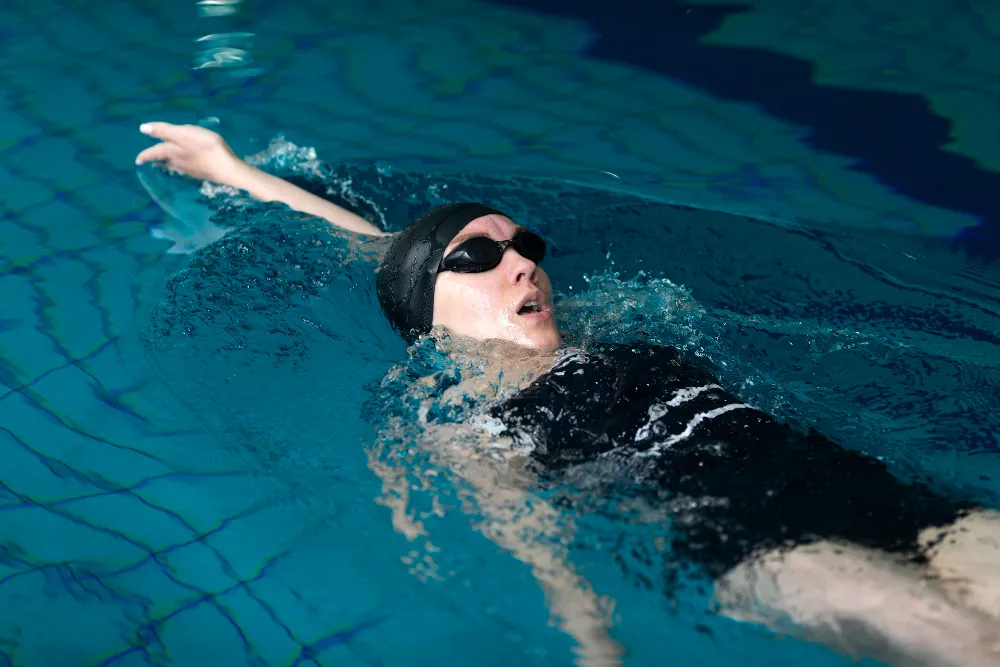
The Backstroke Technique
As we explore the backstroke technique, it’s crucial to focus on our body position and alignment in the water.
By understanding how to coordinate our arm movements effectively, we can enhance our overall performance.
Let’s break down these elements to improve our backstroke together.
Body Position and Alignment
Achieving optimal body position and alignment is crucial for mastering the backstroke technique. When we swim, our body position should be as horizontal as possible, minimizing drag in the water. We need to focus on keeping our head in line with our spine, which helps maintain proper body alignment. If we let our head drop or tilt, we create a body structure issue that can hinder our performance.
To ensure we’re in the proper body position, we should engage our core muscles. This body engagement not only stabilizes our body but also allows for smoother movements through the water.
Keeping our hips high is also essential; if they sink, we’ll increase resistance, making it harder to propel ourselves forward.
As we practice, let’s pay attention to how our arms and legs align with our body. Maintaining a streamlined position will help us maintain speed and efficiency.
Arm Movement Coordination
Mastering arm movement coordination is vital for an efficient backstroke technique. We need to understand that our arm motion plays a crucial role in propulsion and balance. As we alternate our arms, we must maintain a smooth and fluid motion, ensuring one arm enters the water while the other exits, creating a seamless rhythm. This demands considerable coordination, not just with our arms but also in coordination between legs.
While we swim, let’s remember that our legs provide essential support and stability. Our kick should complement our arm strokes, enhancing our overall propulsion. Unlike the butterfly style, where both arms move simultaneously, the backstroke requires us to focus on independent arm movements. This can be a demanding stroke, but with practice, we can achieve that synchronized flow.
As we hone our technique, paying close attention to the timing and strength of our arm motion will yield the best results. By working on our coordination and maintaining a consistent rhythm, we’ll find ourselves gliding through the water more efficiently, making the backstroke feel less strenuous and more enjoyable.
Let’s embrace the challenge and improve our swimming together!
Understanding Breaststroke
Breaststroke is often regarded as one of the most challenging swimming styles to perfect, requiring a unique blend of technique and timing. When we dive into the world of competitive breaststroke, we realize just how intricate this stroke can be. Mastering the correct breaststroke technique isn’t just about moving through the water; it’s about synchronizing our movements to create an efficient flow.
To help us appreciate the depth of this stroke, let’s consider some key aspects:
- The precision of the breaststroke kick that propels us forward.
- The rhythm we must establish to maintain speed and efficiency.
- The importance of timing our breath with each stroke.
- The mental focus needed to overcome challenges.
As we practice, we’ll encounter hurdles that test our resolve, but embracing these challenges is what makes us better swimmers.
By honing our skills in the breaststroke, we not only improve our performance but also deepen our understanding of how technique impacts speed in the water.
Let’s embrace the journey and strive for excellence in our breaststroke!
Challenges of Butterfly Stroke
Having explored the complexities of breaststroke, we now face the unique challenges presented by the butterfly stroke. Often regarded as the hardest stroke, butterfly demands not just technical skill but also exceptional physical conditioning. As butterfly swimmers, we encounter hurdles that can make mastering this stroke quite daunting.
| Challenge | Description |
| Upper Body Strength | Strong arms and shoulders are crucial for propulsion. |
| Breathing Pattern | Timing our breaths is essential to maintain rhythm. |
| Core Engagement | A strong core helps stabilize our body during the stroke. |
| Coordination | Synchronizing arms and legs requires practice and precision. |
The butterfly stroke’s unique rhythm often leads to fatigue, and we need to develop endurance to execute the movements effectively. The demands on our upper body strength are significant, as we pull ourselves through the water while maintaining a steady breathing pattern. Each of these challenges pushes us to refine our technique, build our strength, and enhance our overall performance in the pool. By understanding and addressing these obstacles, we can make strides toward becoming more proficient butterfly swimmers.
Comparing Stroke Difficulty
When it comes to assessing the difficulty of various swimming strokes, we often find ourselves grappling with a range of factors that contribute to each stroke’s unique challenges. Each stroke requires different techniques and levels of strength, making it hard to pinpoint a definitive hardest stroke.
We can all agree that some strokes can be particularly daunting. Consider the following:
- The butterfly stroke demands incredible coordination and strength.
- The backstroke’s technical elements can be tricky to master.
- Freestyle might seem simple, but it requires stamina and speed for competitive swimming.
- The breaststroke’s timing can be a real head-scratcher for many.
Each of these strokes presents its own set of challenges, from the technical precision needed to execute them correctly to the full-body workout they provide.
As we dive deeper into our swimming journeys, we discover that the most challenging swimming stroke often depends on our individual strengths and weaknesses.
Ultimately, our experiences shape our perspectives, and what might be tough for one swimmer could be easier for another.
Factors Affecting Stroke Difficulty
When we think about stroke difficulty, technique and form play a huge role in how challenging each stroke can be.
Additionally, our physical conditioning requirements can impact our performance and endurance in the water.
Let’s explore how these factors shape our swimming experience and the overall difficulty of each stroke.
Technique and Form
Technique and form play crucial roles in determining the difficulty of a swimmer’s stroke. We often underestimate how essential these elements are in maximizing efficiency and minimizing effort.
When we focus on our technique, it can make a significant difference in our performance. A well-executed stroke not only conserves energy but also enhances speed.
Let’s consider some factors that can heighten the challenge of mastering swimming strokes:
- The alignment of our body impacts how streamlined we’re in the water.
- Proper movement patterns prevent unnecessary drag and improve propulsion.
- The coordination of our arms and legs requires precise timing and rhythm.
- Each stroke demands a unique set of techniques, making it tricky to master them all.
Physical Conditioning Requirements
Mastering swimming strokes isn’t just about technique; it’s also about the physical conditioning required to execute them effectively. For the majority of people, achieving proficiency in a competitive stroke demands a solid foundation of fitness.
We need to focus on building strength and endurance, especially in our core muscles, which play a crucial role in stabilizing our bodies in the water. A strong core allows us to maintain proper body alignment, which enhances our overall performance and efficiency.
Additionally, flexibility is key; improving our range of motion can significantly impact our stroke mechanics. Without it, we may struggle to achieve the fluidity necessary for advanced strokes like the butterfly or backstroke.
To meet the physical conditioning requirements for swimming, we should engage in targeted strength training, aerobic exercises, and flexibility routines. These components won’t only help us swim faster but also reduce the risk of injury.
Ultimately, by prioritizing our physical conditioning, we can elevate our swimming performance and tackle even the hardest strokes with confidence. Let’s commit to training our bodies to meet these challenges and enjoy the rewards that come with it!
Training Tips for Each Stroke
In the pursuit of improving our swimming skills, we can benefit from tailored training tips for each stroke. Each stroke presents unique challenges, especially when considering the hardest style to master.
Here are some key training tips we can implement:
- Focus on stroke variation: Mixing up our strokes helps to develop a well-rounded technique and prevent boredom.
- Prioritize proper breathing: Mastering our breathing technique is crucial. Let’s practice breathing drills to improve our rhythm and efficiency in the water.
- Build endurance over time: We should gradually increase our distance and intensity in practice sessions to enhance our stamina, allowing us to swim longer without fatigue.
- Incorporate strength training: Strengthening our core and upper body can significantly improve our stroke efficiency, especially in the more challenging strokes.
Personal Experiences From Swimmers
Swimming journeys are filled with unique challenges and triumphs, and personal experiences from fellow swimmers can offer invaluable insights. As we dive into the water, we often find ourselves grappling with different strokes and their demands. For many of us, the backstroke stands out as a particularly difficult stroke.
We’ve heard from marathon swimmers who emphasize the importance of mastering our breathing technique, especially when we’re navigating longer distances. One swimmer shared how struggling with backstroke breathing initially felt like an uphill battle. They described the sensation of water splashing in their face, making it hard to maintain a steady rhythm. Yet, with persistence and practice, they found that focusing on their body position made all the difference.
Another swimmer recounted how the backstroke challenged their coordination. They learned that keeping a consistent kick while reaching back with their arms transformed their performance.
These stories remind us that while we may face difficulties, we can also draw strength from each other’s experiences. Embracing these challenges not only builds our skills but also strengthens our love for swimming. Each stroke, no matter how difficult, adds to our journey in the water.
Final Thoughts on Stroke Difficulty
Every swimmer’s journey is a testament to the challenges we face with different strokes, and it’s clear that some are inherently more difficult than others. As we strive to become successful swimmers, we must confront our biggest challenges head-on.
Whether it’s mastering stroke tech or building endurance over time, we all have our struggles.
Consider the following aspects that can make strokes particularly tough:
- The complexity of technique required for each stroke
- The physical demands that test our endurance
- The mental hurdles we must overcome
- The necessity of consistency to develop our dominant stroke
Each stroke has its unique difficulties, and understanding these can help us improve.
While we may each have a dominant stroke, it’s essential to acknowledge that every swimmer has their own set of challenges. By focusing on stroke tech and pushing through the toughest moments, we’ll not only enhance our skills but also grow as athletes.
Frequently Asked Questions
How Do Swimming Strokes Impact Overall Fitness Levels?
We know swimming strokes significantly enhance our overall fitness levels. Each stroke targets different muscle groups, improves cardiovascular health, and boosts endurance, making our workouts varied and effective for achieving our fitness goals together.
What Are Common Injuries Associated With Each Stroke?
We often encounter injuries while swimming, like shoulder pain from freestyle, knee issues with breaststroke, and lower back strain due to butterfly. It’s crucial to maintain proper technique and strength to minimize these risks.
Can Swimming Strokes Improve Mental Health?
Absolutely, we’ve found that swimming strokes can significantly boost our mental health. They help reduce stress, improve mood, and enhance overall well-being. Let’s dive in and experience the mental benefits together!
Which Stroke Is Most Popular Among Competitive Swimmers?
When we think about competitive swimming, freestyle stands out as the most popular stroke. Its speed and efficiency make it a favorite among swimmers, allowing us to showcase our skills in various competitions.
How Does Age Affect Stroke Proficiency and Difficulty?
Age definitely impacts our stroke proficiency and difficulty. As we grow older, our physical capabilities change, affecting technique and endurance. Staying active can help us maintain and improve our swimming skills, regardless of age.
Final Thoughts
In the grand tapestry of swimming, each stroke weaves its own story of challenge and triumph. In our previous discussion on What Happens if You Don’t Wash Chlorine off Your Body?, we explored the effects of lingering chlorine and the importance of proper skincare after swimming. While many of us might consider the butterfly the toughest, the beauty lies in our unique experiences. Just like a symphony, every stroke requires its own rhythm and harmony. As we dive into the depths of each technique, we discover not just the strokes themselves, but also the determination and resilience that push us to become better swimmers. Let’s embrace the journey together! And if you’re wondering, What Is the Healthiest Swim Stroke?, let’s explore that next.


